
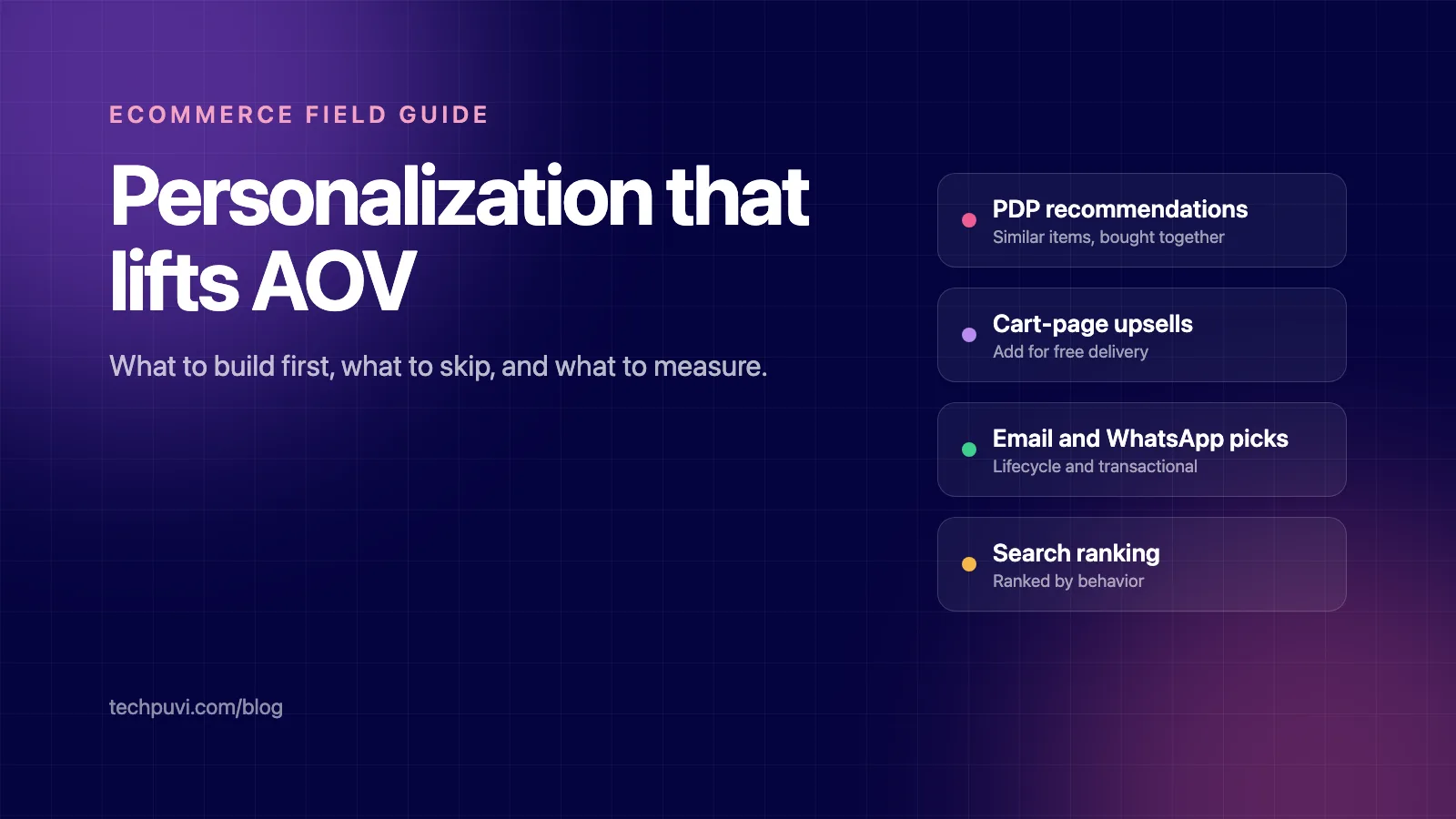
Most "personalization" features ship as demos and never move a number. This guide is for founders, product leads and engineering teams running an Indian store who want to know which eCommerce personalization features actually lift average order value (AOV), which ones to skip, and in what order to build them. The ones that move AOV in Indian eCommerce are specific and tend to be unglamorous. Here is the field-tested view.
Key takeaways: what lifts AOV and what does not
Every personalization feature has engineering cost. Choose the ones that move the metric; skip the ones that do not. Here is how the common options compare.
Feature | AOV impact | Engineering cost and caveats |
|---|---|---|
Recommendations on PDP and cart | Real lift (5-15%) | Proven and measurable; start here |
Search result ranking personalization | Real lift | Harder to A/B isolate |
Personalized email subject lines and product picks | Real lift | Works across email, WhatsApp and SMS |
Browse history nudges | Small lift | Low cost |
Dynamic homepage by behavior | Marginal lift | High engineering cost |
Personalized pricing | Mostly hype in retail | Tested in subscription; trust risk in retail |
Personalization features that lift AOV in Indian eCommerce
Product detail page recommendations
"Customers who bought this also bought" or "Similar items": proven and measurable. These widgets sit at the moment a shopper is already interested, which is why they convert. Use collaborative filtering plus content embeddings so new products without purchase history still get recommended (the cold-start problem).
Cart-page upsells
"Frequently bought together" or "Add for free delivery": common and effective. A free-delivery threshold gives the shopper a concrete reason to add one more item, and the cart is where the order value is decided.
Email and notification personalization
Personalized product picks in transactional and lifecycle emails consistently lift conversion. The same holds for WhatsApp and SMS personalization, which matter a great deal for Indian shoppers who live in their messaging apps.
Search ranking by behavior
Users who buy electronics see electronics-relevant results ranked higher. It is hard to A/B isolate, but the cumulative effect is real. If you are deciding whether you need a hosted search service for this, our guide on when Algolia is overkill for eCommerce search walks through the trade-offs.
Browse history nudges
A "You were looking at X" placement on the homepage when a shopper returns: small lift, low cost. It is a cheap win to ship once recommendations are in place.
What does not work (yet)
Dynamic homepage rebuilding
Completely personalized homepages do not outperform well-curated, category-anchored homepages by enough to justify the engineering. A clear, merchandised homepage with a browse history nudge gets most of the value for a fraction of the work.
Personalized pricing in retail
Discount banding by behavior risks PR and trust issues. Use it sparingly, if at all. Where it has been tested is subscription businesses, not general retail.
Voice and face-based personalization
Cool demo. It has not moved AOV in Indian retail at scale.
The AI angle: how modern recommendation engines work
Modern recommendations use embedding-based similarity, which is much better than the old collaborative filter alone. In practice the strongest setup is hybrid:
Collaborative signals: what similar shoppers bought together.
Content signals: embeddings of product titles, descriptions and attributes, so a new product has neighbours on day one.
Popularity: a sensible fallback when a shopper has little history.
Hybrid (collaborative + content + popularity) beats pure embedding. Add behavioral signals such as recent views and cart abandons for cold-start.
For Indian eCommerce specifically, language signals matter: surface descriptions in the user's preferred language, even if the catalog is multilingual. We cover more on vernacular audiences in Building for Bharat.
Common pitfalls in eCommerce personalization
Pitfall | Why it hurts | What to do instead |
|---|---|---|
A/B testing for too short a window | Personalization lift compounds over weeks; one-day tests show noise | Run tests long enough to see the compounding effect |
Over-personalizing on early signal | Cold-start matters; over-fitting on 2 page views misreads intent | Blend early signals with content and popularity |
Recommending what is out of stock | Shoppers click and hit a dead end | Make inventory awareness non-negotiable |
Filter bubbles | If you only show what users have viewed, they never discover anything new | Mix exploration with exploitation |
What we recommend
Start with PDP recommendations and cart-page upsells. Measure AOV lift. Add search ranking personalization next. Skip the heavy dynamic-homepage work until everything simpler is exhausted.
Personalization sits on top of the rest of your stack, so it helps to have the foundations right first. Our D2C brand stack for 2026 covers the storefront, OMS and analytics pieces it depends on, and our headless commerce comparison explains how the storefront choice affects where recommendation widgets can live.
Choose the personalization that moves the metric, and measure it over weeks, not days.
FAQs
Algolia Recommend vs custom?
Algolia is faster to ship; custom is more flexible at scale.
Real-time vs batch recommendations?
Batch (overnight) is fine for most recommendations; real-time only matters for cart-page contextual recommendations.
How much AOV lift can we expect?
5-15% AOV lift is realistic; 30%+ claims are usually selection bias.
Planning recommendations, upsells or search ranking for your store? See our AI integration services and our work across eCommerce, then talk to Techpuvi about AI personalization.