
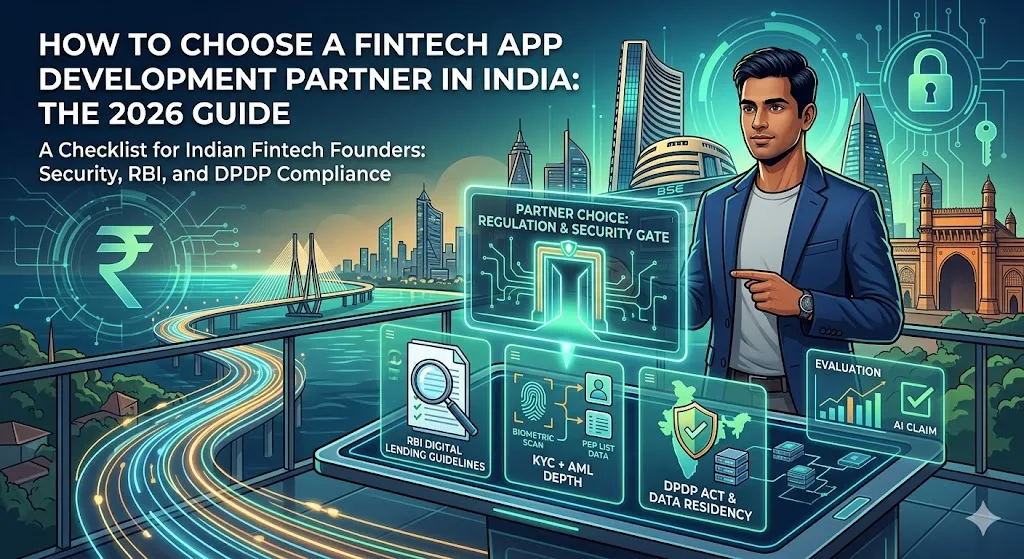
How to Choose a Fintech App Development Partner in India (2026 Guide)
Choosing the wrong fintech development partner doesn't just cost you a launch, it costs you a regulator inspection, a data residency violation, or a security incident that ends your funding round. This guide is the checklist Indian fintech founders should run before signing the contract.
Key takeaways
- Demand specific evidence of RBI digital lending guidelines knowledge, generic "we work in fintech" is not enough.
- Verify they've shipped a working KYC + AML stack, not just integrated one library.
- Get clarity on code ownership, repo handover, and the post-launch retainer model in writing before kickoff.
- Ask about their evaluation rubric for the AI features they're claiming they'll add.
- A great partner shows you a runbook and an audit trail. A weak one shows you a portfolio.
Why this matters
Fintech in India is regulated tighter than most consumer software categories. RBI's digital lending guidelines, the Account Aggregator framework, ONDC, the DPDP Act, and SEBI's cybersecurity framework all impose requirements that show up in architecture, not just legal pages. A development partner who doesn't understand them will ship code that passes initial review and fails audit twelve months later. That's a real cost: re-architecture, regulator escalation, customer notification, lost market window.
The 9-point evaluation checklist
1. RBI experience, ask for specifics
Don't accept "we've built fintech apps." Ask: "Have you shipped a product that went through an RBI inspection? What did the inspection ask for that you had to scramble to provide?" Real answers reveal real experience.
2. KYC + AML depth
A weak partner integrates HyperVerge or Karza and calls it done. A strong partner has opinions on which provider wins for video KYC vs OCR-only flows, has implemented sanction screening with PEP lists, and has handled the edge cases (failed liveness, document fraud, cross-border ID).
3. DPDP and data residency
Are they using AWS Mumbai or GCP Hyderabad? Where do their backups go? What's their stance on the cross-border transfer rules? If they say "we're DPDP compliant" without specifics, walk away.
4. Account Aggregator framework
If your product touches financial data, AA is the future. A partner who has shipped at least one AA integration, even for a pilot, is worth a premium over one who's only read about it.
5. Security posture
Ask: How do you do secrets management? Where do production credentials live? Do you do code reviews and threat modeling? Do you offer pentests post-launch? If they don't have crisp answers, security will be an afterthought.
6. Code ownership and repo handover
Every line of code you pay for should be in your repo, under your GitHub org, from commit one. Some agencies hold code hostage. Make ownership explicit in the contract.
7. The retainer model
Post-launch matters as much as launch. Ask: What's your retainer rate? What's the response SLA? Do you have weekend on-call? A partner with a clear retainer offering is a partner who plans to be there in month 7.
8. AI claims
Everyone says "AI-powered." Ask what they actually mean. What's the eval rubric? What happens when the model hallucinates? Who pays for the OpenAI bill?
9. References they don't pick
Ask for a customer reference, but then ask if you can talk to a customer they didn't suggest. Strong partners say yes.
Red flags
- Fixed bids on un-scoped work. Real fintech work has unknowns; pretend-precise bids hide cost overruns.
- "We can do everything." Strong partners say no to projects outside their core.
- No questions about regulators in the first call. If they're not curious, they don't know.
- Pricing dramatically below market. KYC + RBI + AML expertise costs real money. Cheap usually means corner-cut.
What a strong partner looks like
A strong partner shows up to the first call having read your website, your funding announcement, and the relevant regulator circulars. They ask specifically about your customer cohort, your data volumes, and your inspection timeline. They have a written approach to threat modeling. They name the providers they'd use and why. They have a Friday-evening retainer rate and they don't apologize for it.
FAQs
Should we hire an Indian agency or a global one for our fintech build? For Indian fintech, almost always Indian. RBI experience, regulator relationships, and on-ground KYC integration depth tilt strongly local.
How much should a lending platform MVP cost? Mid-range for a KYC + underwriting + disbursement MVP is ₹40L-₹1Cr depending on integrations. Wildly cheaper offers usually mean wildly cheaper outcomes.
Should we let them use AI to write code? Yes, but ask how they review AI-generated code, especially for security-sensitive paths.
Who owns the customer data? You always do. Verify the data processing agreement says exactly that.
Talk to Techpuvi about BFSI software development. RBI-compliant by design, DPDP-ready, AI where it earns its place.