
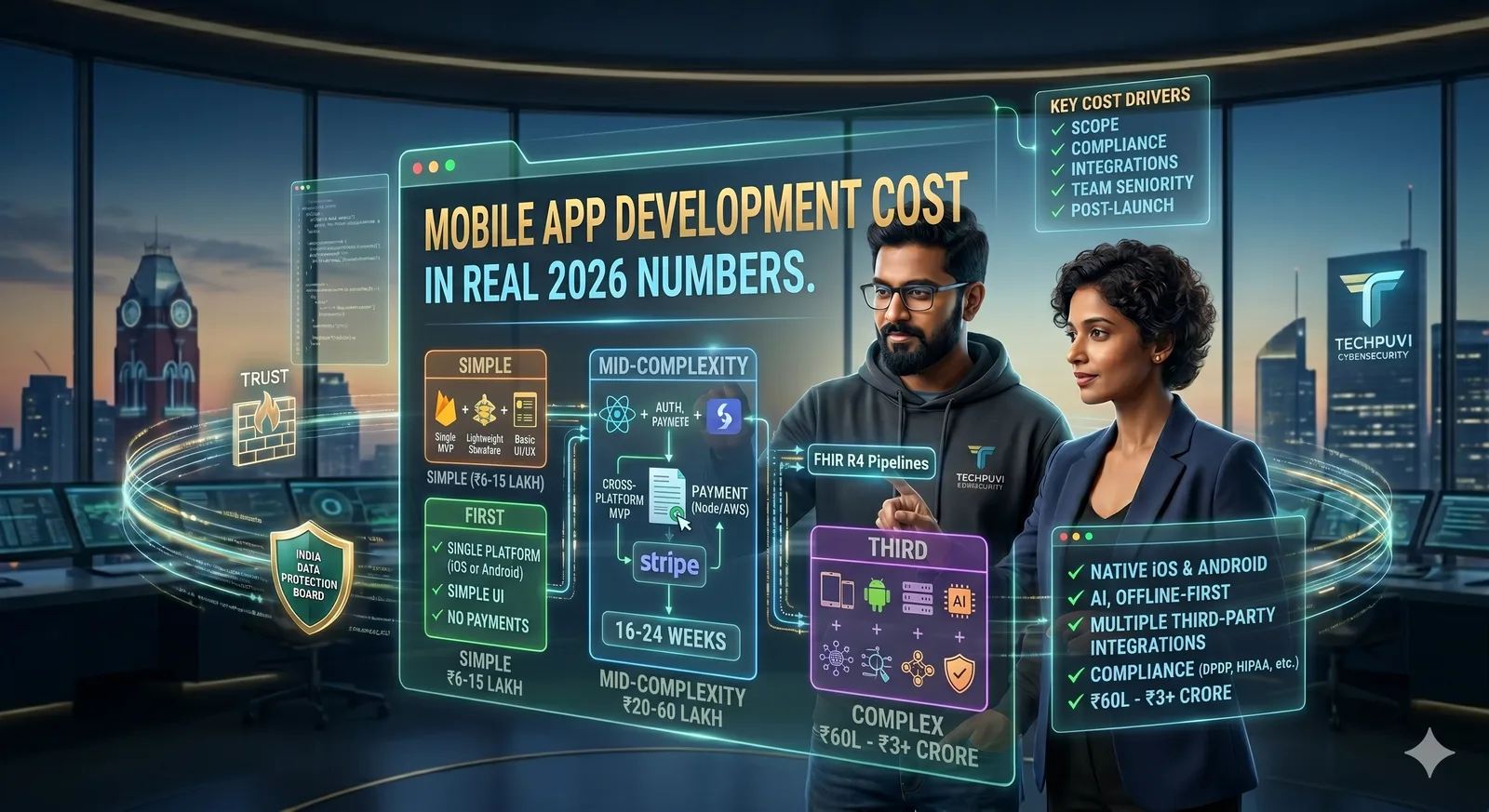
How Much Does Mobile App Development Cost in India? (Real 2026 Numbers)
Every founder who's ever asked "how much for an app?" has heard wildly different numbers, ₹5 lakh from one shop, ₹50 lakh from another, ₹2 crore from a third. The variance isn't dishonesty; it's that "an app" describes products that share almost nothing structurally. Here are the real ranges in India for 2026, with the variables that drive the bill.
Key takeaways
- Simple app (single-platform MVP, no backend complexity): ₹6-15 lakh
- Mid-complexity app (cross-platform, backend, auth, payments): ₹20-60 lakh
- Complex app (multi-platform, integrations, AI, compliance): ₹60 lakh-₹3+ crore
- Cost drivers, in order: scope, integration depth, compliance, team seniority, post-launch retainer
Why pricing varies so much
A "mobile app" can be: a simple WebView wrapper, a native consumer app, a fintech app with KYC and lending, a healthcare app with ABDM and HIPAA, an enterprise app with SSO and audit trails. Each is a different product. Pricing collapses meaningfully only once scope is concrete.
The three tiers
Simple (₹6-15 lakh)
A single platform (iOS or Android), straightforward UI, lightweight backend (Firebase or similar), basic auth, no payments. Examples: directory app, content reader, simple booking app for a small business.
Typical timeline: 8-12 weeks. Team: 1 mobile engineer + 1 designer part-time. Post-launch: minimal maintenance.
Mid-complexity (₹20-60 lakh)
Cross-platform (React Native or Flutter) or both native platforms. Real backend (Node/Python on AWS or GCP). Auth, role-based access, payment integration (Razorpay/Stripe), push notifications, deep links, basic analytics. Examples: marketplace, fitness tracking, e-commerce shopping app, EdTech learner app.
Typical timeline: 16-24 weeks. Team: 2 mobile engineers + 1 backend engineer + 1 designer + part-time PM. Post-launch: retainer of ₹2-6L/month.
Complex (₹60 lakh-₹3+ crore)
Native iOS and Android, complex backend (multi-tenant, scaling, real-time), KYC + payments + compliance, AI features, integrations with multiple third parties, offline-first architecture. Examples: fintech lending platform, healthcare patient + clinician dual app, logistics driver + dispatcher + warehouse system.
Typical timeline: 6-18 months for V1. Team: 4-10 engineers, designers, PM, QA, DevOps. Post-launch: retainer of ₹6L-₹25L/month.
What actually drives the cost
Integration count and depth. Three integrations = a few weeks. Twelve integrations = a few months. Each integration has docs, edge cases, sandbox testing, prod testing.
Compliance. Adding HIPAA, DPDP, RBI, or SOC 2 alignment can add 30-60% to a project budget. Worth it; non-negotiable in regulated verticals.
Real-time and offline. Real-time sync, conflict resolution, and offline-first architecture roughly double the engineering effort vs a server-of-truth app.
Team seniority. A senior engineer at ₹2.5K/hour ships in a week what a junior at ₹800/hour ships in a month. The senior is cheaper on the actual delivery, almost always.
Post-launch realities. App stores reject for reasons. Devices fragment. iOS 19 ships and breaks things. Budget for 15-25% of build cost in year-1 maintenance.
How to read a quote
A trustworthy quote breaks cost down by phase, by team role, and by milestone. It states assumptions explicitly. It includes a contingency. It is not a single number with no decomposition. If you can't see what your money is buying, you don't know what your money is buying.
What we recommend
Get three quotes, but make them comparable: same scope document, same assumptions, same milestones. The cheapest is rarely the right pick; the second cheapest with the strongest team usually is. Always reserve 15-20% of budget for things you didn't anticipate at quote time.
FAQs
Can we build for under ₹5 lakh? Maybe, but it'll either be a thin WebView wrapper or short-lived freelancer code that needs replacing within a year.
Fixed price or time-and-materials? Fixed for well-scoped V1; T&M with not-to-exceed for discovery-heavy or evolving work.
Cross-platform or native? Cross-platform for budget-tight, simple-UX apps; native for everything with real performance, sensor, or platform-specific needs.
Why is iOS often more expensive than Android? Mac hardware for builds, App Store review unpredictability, stricter design conventions. Usually 10-20% more.
See how Techpuvi approaches mobile development. Honest scoping, senior teams, post-launch retainers when you need them.