
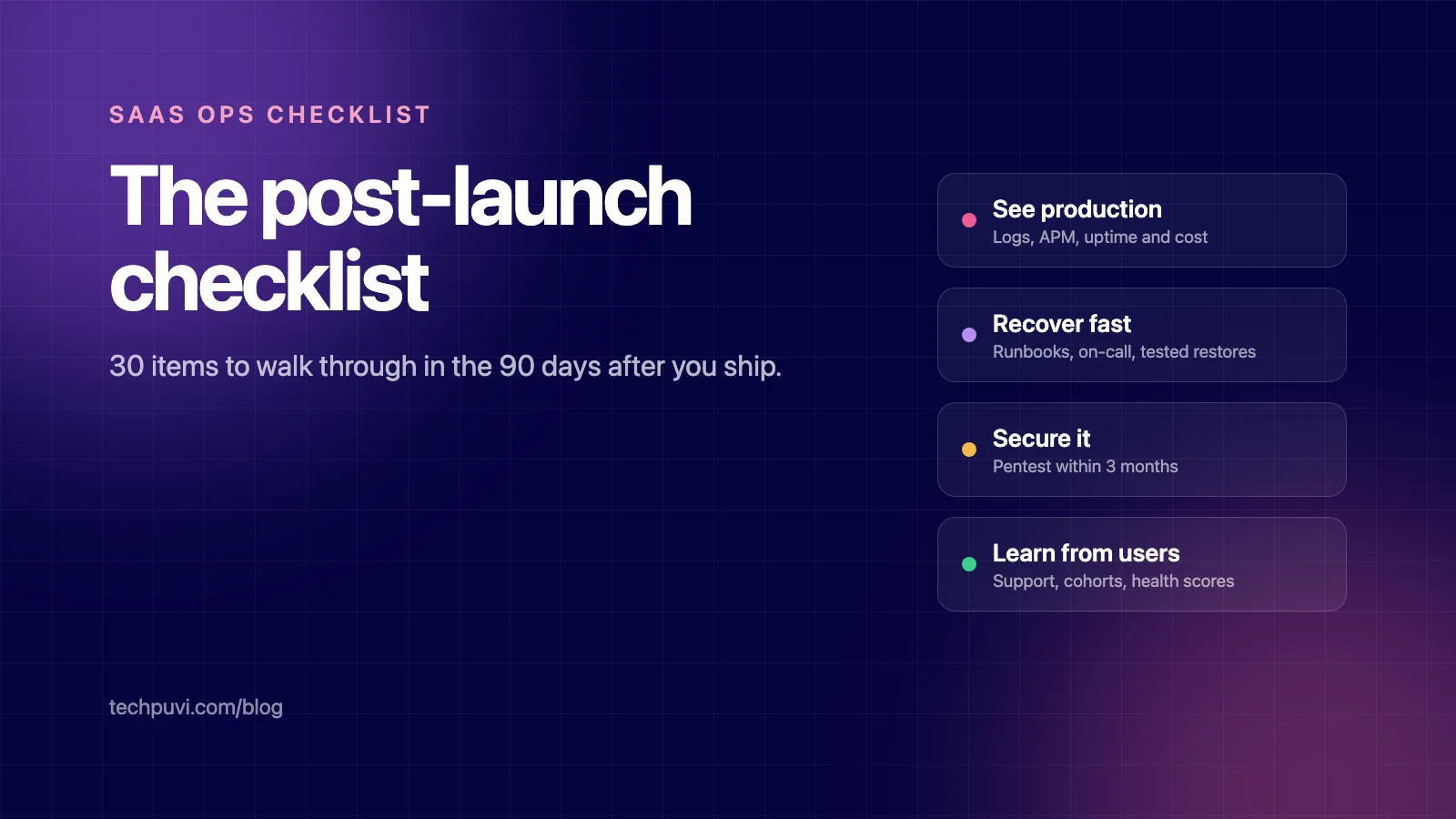
Launch is exhilarating. The 90 days after are where SaaS companies are quietly made or broken. This post-launch SaaS checklist is for founders and engineering leads who have just shipped: it lists 30 things most teams skip after launch that come back to haunt them, grouped into six areas, with what good looks like for each one.
The checklist at a glance
The list covers observability, operations, security, support, analytics, growth, and team. Skip them at your peril. Here is how the 30 items break down before we go through each one.
Area | Items | What it protects |
|---|---|---|
Observability | 1 to 5 | Your ability to see what production is doing, and what it costs |
Operations | 6 to 10 | How fast you recover when something breaks |
Security | 11 to 15 | Who can reach your systems and your customers' data |
Support | 16 to 20 | How customer problems reach the people who can fix them |
Analytics | 21 to 25 | Whether you know which users get value and which drift away |
Growth | 26 to 30 | The engines and the team that carry you past launch |
Observability: see production clearly (items 1 to 5)
You cannot fix what you cannot see. These five items make sure that when a customer says "it is slow", you already have the trace, the log line and the region it happened in.
# | Item | What to do |
|---|---|---|
1 | Centralize logs | Not in the app, not in CloudWatch alone. Datadog, Grafana Loki, or equivalent. |
2 | Application performance monitoring | An APM trace for every request. Datadog APM, Sentry Performance. |
3 | Real user monitoring | Frontend performance from actual users' browsers. |
4 | Synthetic monitoring | Uptime checks from multiple regions. |
5 | Cost dashboards | Monthly AWS/GCP cost broken down by service. |
Cost belongs in observability because a bill that is not broken down by service cannot be reasoned about. For a worked example of keeping infrastructure spend in check, see how we keep Kubernetes costs under ₹50K/month for early-stage SaaS.
Operations: runbooks, on-call and recovery (items 6 to 10)
Operations is about the bad day. Each item here shortens the time between "something is wrong" and "it is fixed, and customers know".
# | Item | What to do |
|---|---|---|
6 | Runbooks for the top 5 incidents | Database is down. Payment processing fails. Email delivery breaks. Auth provider outage. CDN slow. |
7 | On-call rotation | Even for a small team. Use PagerDuty, Opsgenie, or BetterStack. |
8 | Backup verification | Test a restore monthly. |
9 | Disaster recovery plan | What are your RPO and RTO? Documented. |
10 | Status page | Public (statuspage.io, instatus) for customer trust. |
RPO (recovery point objective) is how much data you can afford to lose, and RTO (recovery time objective) is how long you can afford to be down. Writing both down turns item 9 from a vague intention into a target your backups and runbooks can be checked against.
Security: the first months after launch (items 11 to 15)
Security work is easiest to schedule early, before the number of people, services and secrets in production multiplies.
# | Item | What to do |
|---|---|---|
11 | External pentest | Get one within 3 months of launch. |
12 | Dependency scanning | Snyk, Dependabot, Trivy. Automated. |
13 | Secrets rotation | Quarterly minimum. |
14 | Access reviews | Quarterly: who has prod access? Why? |
15 | Security training | Annual. Not optional. |
Rotation is far less painful when secrets were never scattered in the first place. Our guide on keeping secrets out of your projects covers the habits that make item 13 a routine task rather than an emergency.
Support: getting customer problems to the right people (items 16 to 20)
Early customers forgive bugs. They are far less forgiving of silence. These items make sure every report has a home, an owner and a response time.
# | Item | What to do |
|---|---|---|
16 | Support tool | Helpscout, Intercom, Zendesk. Pick one. |
17 | Knowledge base | Articles for the top 20 questions. |
18 | SLA documented | Response time commitments to customers. |
19 | Bug triage process | Where do customer-reported bugs go? Who decides priority? |
20 | Customer feedback loop | How does feedback reach product? |
Analytics: activation, retention and health (items 21 to 25)
Analytics answers the question launch day cannot: are people getting value, and are they staying?
# | Item | What to do |
|---|---|---|
21 | Product analytics | Mixpanel, Amplitude, PostHog. Wire the core events. |
22 | Conversion funnel | Signup, then activation, then first value. Measured. |
23 | Retention cohorts | Weekly cohorts; track activity over time. |
24 | NPS or CSAT | Wootric, Delighted. Quarterly minimum. |
25 | Health score model | A per-account health score driving CS interventions. |
A health score is only useful if someone acts on it. If you are deciding how to run that side of the business, our breakdown of customer success software for SaaS covers what to build and what to buy.
Growth and team: what carries you past launch (items 26 to 30)
The last five items are the engines that bring in the next customers and the people who will run them.
# | Item | What to do |
|---|---|---|
26 | SEO foundation | Sitemap, robots, structured data, Open Graph. |
27 | Blog/content engine | A publishing cadence. |
28 | Email lifecycle | Welcome, activation, milestone, retention. |
29 | Partnership pipeline | Integration partners, referral partners. |
30 | Hiring plan | The next 3 hires, with role priority. |
For the hiring plan, our notes on hiring senior engineers in India describe what we look for when a role is high on that priority list.
What we recommend
Walk the list within 90 days of launch. Tick what is done; schedule what is not. Most teams skip 10 to 15 of these and pay for it in months 6 to 12.
Tick what is done; schedule what is not.
FAQs
Do we need all 30 at launch?
No. The first 10 are urgent (observability, operations and security). Spread the rest over 3 months.
Who owns the post-launch checklist?
The engineering lead, with founder oversight. CS and growth own their sections.
What about compliance items (SOC 2, etc.)?
That is a separate track, and we have a dedicated post on it: SOC 2 readiness for Indian SaaS.
Want a second pair of hands on the list? Talk to Techpuvi about post-launch engineering, or see how our full-stack development team supports SaaS products after launch.