
Real estate listing platform SEO is an arms race, and the platforms that win it share technical foundations most competitors skip. This guide is for founders, product leads and engineering teams building or rebuilding a property portal. It covers the architecture that ranks: URL structure, structured data, internal linking, content depth per listing, performance, faceted search and what changes for India.
Key takeaways for listing platform SEO
URL structure must encode locality, property type and key attributes.
Structured data (the
RealEstateListingtype plusBreadcrumbList) helps search engines understand each page and earns breadcrumb rich results.Internal linking through location hubs and category pages matters more than backlinks for most queries.
Performance, especially on mobile, is a major ranking factor.
Content depth per listing matters; thin listings rank poorly.
URL structure: encode location, type and attributes
Your URL is the first signal a crawler and a searcher read. A good one tells both exactly where the property sits and what it is before the page even loads.
Pattern | Example | Why |
|---|---|---|
What works |
| Encodes country, state, city, locality and listing. Predictable, hierarchical and keyword-rich. |
What fails |
| Opaque, carries no keywords and is hard to crawl. |
The hierarchy also gives you your hub pages for free: every segment of the good URL above is itself a page worth ranking, which is the backbone of the internal linking section below.
Structured data for real estate listings
Use the RealEstateListing type from Schema.org, and describe the property itself (rooms, floor size) on the accommodation the listing is about:
{
  "@context": "https://schema.org",
  "@type": "RealEstateListing",
  "name": "3 BHK Apartment in Bandra West",
  "description": "...",
  "offers": { "@type": "Offer", "...": "..." },
  "about": {
    "@type": "Apartment",
    "address": { "@type": "PostalAddress", "...": "..." },
    "geo": { "@type": "GeoCoordinates", "...": "..." },
    "floorSize": { "@type": "QuantitativeValue", "value": 1500, "unitCode": "FTK" },
    "numberOfRooms": 3
  }
}
Add BreadcrumbList and Organization alongside it. Check every template in Google's Rich Results Test and the Schema.org validator before it ships, and again whenever the listing template changes.
Internal linking architecture: hubs, neighbourhoods and cross-links
For most property queries, a dense, logical internal link graph does more than chasing backlinks. It helps Google understand the structure and crawl deeper. Four layers do the work:
Layer | Example | What it links to |
|---|---|---|
Location hubs |
| Lists all Mumbai listings; links to neighbourhood pages. |
Neighbourhood pages |
| All Bandra West listings; links to the listings. |
Category cross-links | "Apartments in Bandra West" | "Apartments in nearby Khar", and similar. |
Related listings | On each listing page | Similar properties nearby. |
Why hubs outrank individual listings
Listings come and go; a locality page stays. Hubs and neighbourhood pages accumulate links and authority over time and pass it down to whatever listings are live today, so a new listing in a strong neighbourhood is discovered and ranked quickly.
Content depth per listing
Thin listings ("3 BHK, ₹2.5 crore, 1500 sqft") rank poorly and bounce fast. Rich listings rank well. A complete listing carries:
A detailed description
Multiple photos with alt text
A virtual tour (our comparison of Matterport versus a custom virtual tour covers the trade-offs)
Locality information: schools, transport and amenities
Pricing history, where available
FAQs about the property
Builder or seller reputation context
Performance and Core Web Vitals on mobile
Real estate search happens predominantly on mobile, so Core Web Vitals matter heavily. Aim for the "good" thresholds on every listing and hub template:
Metric | Target | What it measures |
|---|---|---|
LCP (Largest Contentful Paint) | < 2.5s | How fast the main content, usually the hero photo, appears. Test it on a throttled mobile connection such as Fast 3G. |
CLS (Cumulative Layout Shift) | < 0.1 | How much the page jumps around while loading. |
INP (Interaction to Next Paint) | < 200ms | How quickly the page responds to taps, such as opening filters. |
Image optimisation is the biggest lever: a 4MB hero photo is the most common LCP problem on property sites. Serve resized, modern-format images and reserve their space so they do not shift the layout. For how Indian sites measure up in practice, see our test of Core Web Vitals across 50 Indian websites.
Faceted search: which filter pages to index
Faceted search (price range, bedrooms, locality, amenities) creates many URL combinations. Decide deliberately which ones crawlers may index:
Facet | Examples | Indexing |
|---|---|---|
Major facets | City, locality, bedrooms | index |
Minor facets | Specific amenities | noindex |
Deep combinations | Several filters stacked beyond a set depth | noindex |
Without this, an effectively infinite URL space confuses crawlers and spreads ranking signals across thousands of near-duplicate pages.
Real estate SEO in India: what changes
Vernacular SEO: a search for "Bandra mein flat" should also rank.
Builder and project pages matter: specific RERA-registered projects deserve pages of their own. Our guide to RERA compliance in software covers the disclosures those pages draw on.
Prices in INR with regional understanding: lakhs and crores, not only raw numbers.
Common listing platform SEO pitfalls
Pitfall | What it costs |
|---|---|
Slow listings page | Hurts both user experience and rankings. |
No structured data | Search engines understand the page less well, and breadcrumb rich results are lost. |
Thin descriptions | Ranks poorly; visitors bounce fast. |
Faceted explosion | Too many indexed URLs dilute ranking. |
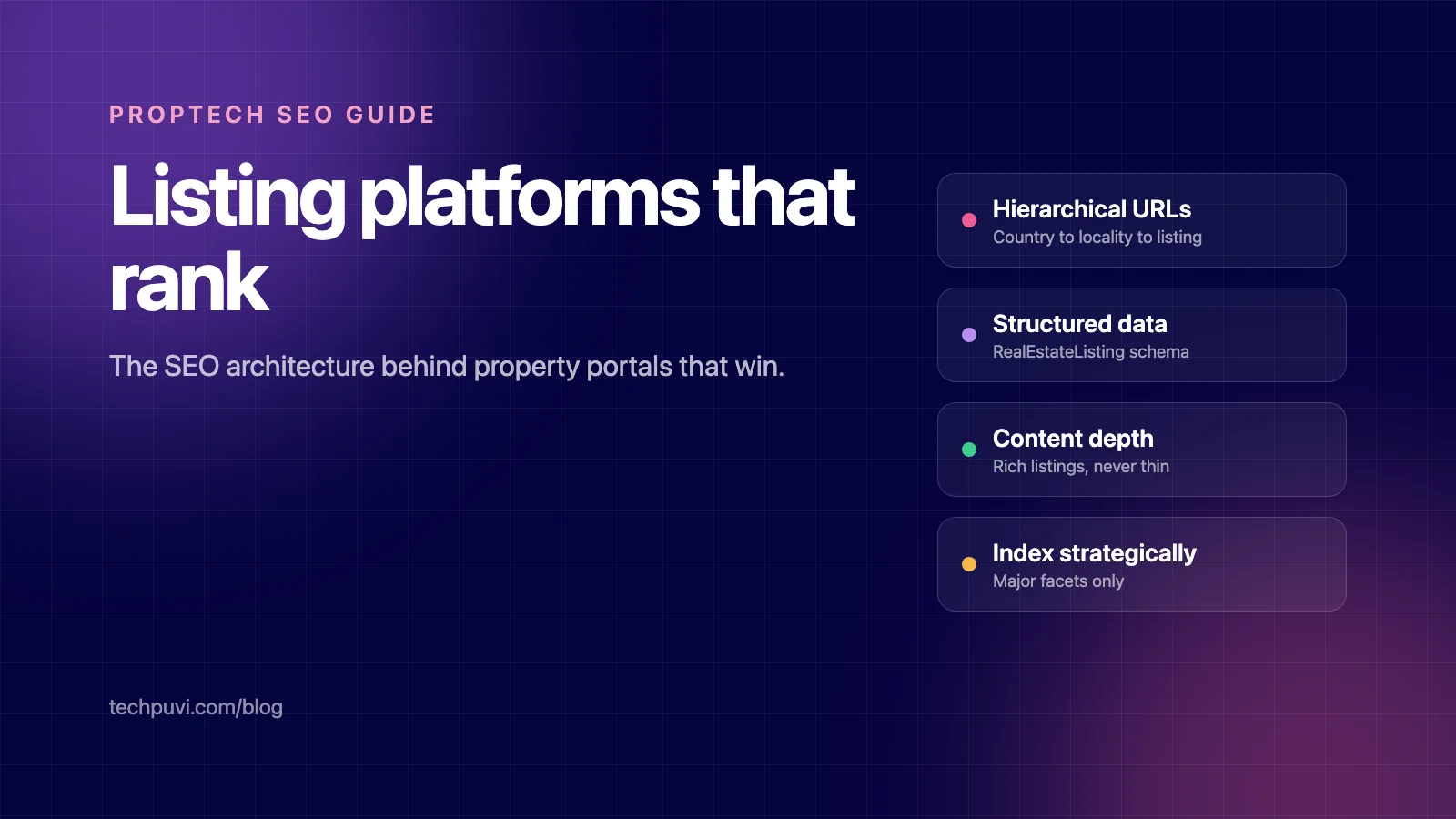
Hierarchical URLs. Rich structured data. Content depth per listing. Performance discipline. Index strategically.
What we recommend
Start with the URL hierarchy, because hubs, breadcrumbs and internal links all hang off it. Generate structured data from the same record that renders each listing. Give every listing real depth, using shared locality data so it scales. Hold every template to the Core Web Vitals targets on mobile, and choose which facets to index before the crawler chooses for you. Search traffic is only half the job; turning it into enquiries is the other half, which our piece on agent CRM for Indian real estate picks up.
FAQs
Can the platform integrate with 99acres and Magicbricks?
Yes: listing syndication and lead-back.
Do we need a mobile app?
An app increases stickiness, but SEO is still web-driven, so the web platform has to rank on its own.
Can listings tie into RERA?
Yes: pull listings tied to RERA-registered projects.
Building or rebuilding a property portal? Talk to Techpuvi about real estate engineering, or explore our work in real estate and PropTech.