
The state of ONDC is easier to read now that the network has been live long enough to separate the hype from the reality. This snapshot is for founders, product teams and seller platforms deciding whether to integrate: which categories have real volume, which are still slow, and what builders should plan for before they commit engineering time.
Key takeaways on where ONDC stands
Strong categories: food delivery, groceries, urban mobility in pilot regions.
Weak categories: long-tail retail, fashion, electronics. High friction, low repeat.
BAP concentration: a few buyer apps drive most consumer-side volume.
Seller adoption: growing but uneven; integration still has rough edges.
Protocol vs operations: the protocol is stable; the operational layer is still maturing.
ONDC category scorecard at a glance
Here is the same picture organised by category, so you can find your own vertical quickly.
Category | Status | Why |
|---|---|---|
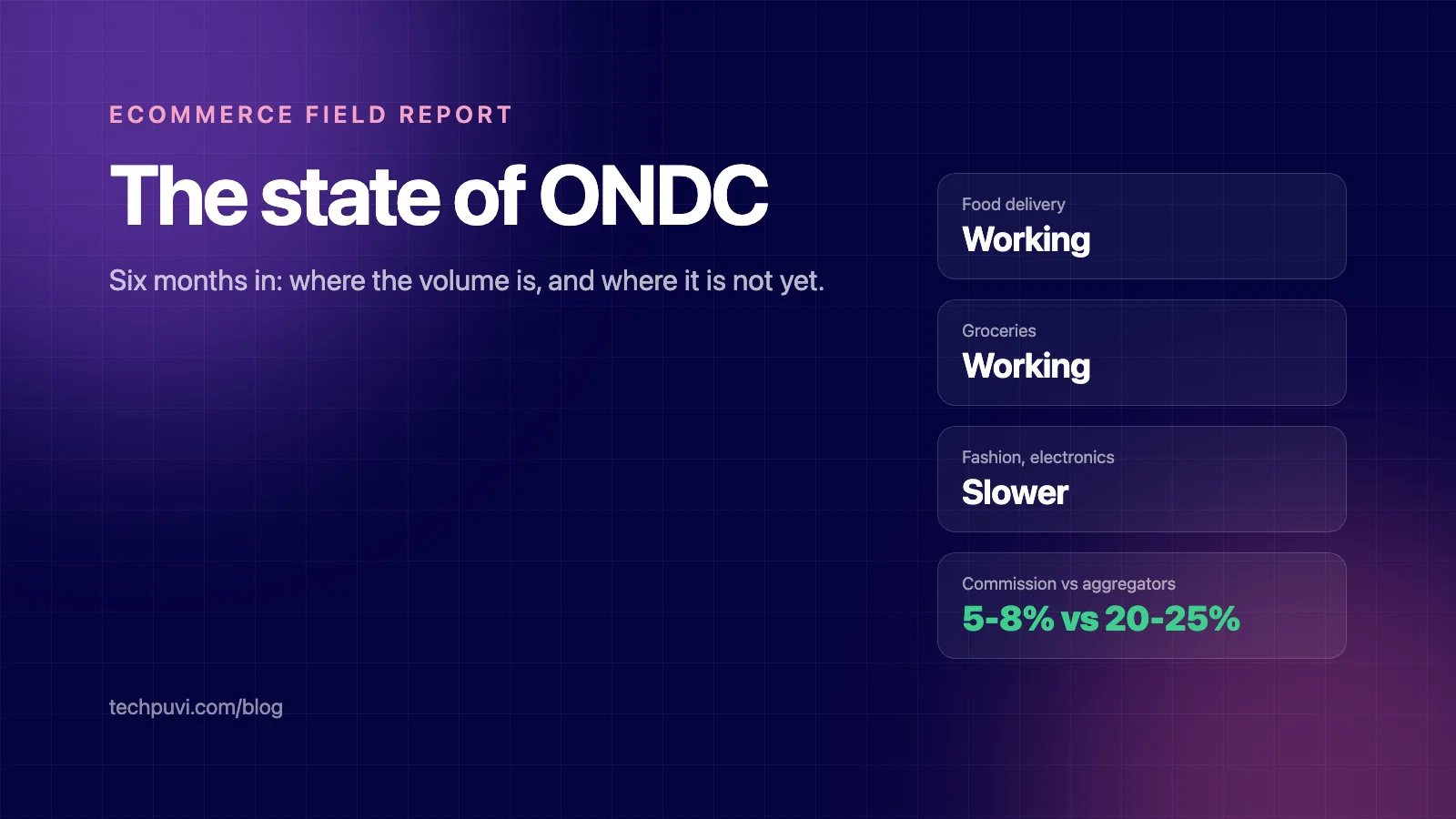
Food delivery | Working | Orders growing; lower commissions than Swiggy/Zomato |
Groceries | Working | Kirana stores gain visibility, especially in tier-2 cities |
Urban mobility | Working in pilots | Functioning in select cities, scale still small |
Fashion and apparel | Slower | High returns, complex sizing, low brand discoverability |
Electronics | Slower | Trust and warranty concerns |
B2B | Pilot stage | Lots of promise, not much volume yet |
Where ONDC is working
Food delivery
ONDC food orders are growing. Lower commissions compared with Swiggy/Zomato are real: often 5-8% on ONDC against 20-25% on the large aggregators. Some quick-commerce players are pushing significant volume through the network.
Groceries
Groceries work especially well in tier-2 cities, where local kirana stores get visibility they previously did not have. If you build for these users, our notes on shipping to tier-2 India users cover the product side.
Urban mobility
Some pilot programs in select cities are functioning, though scale is still small.
Where ONDC adoption is slower
Fashion and apparel
High return rates, complex sizing and low brand discoverability on shared interfaces make fashion a poor fit for now. Returns alone are a heavy operational load, which is why return management for Indian eCommerce deserves a plan of its own.
Electronics
Trust and warranty concerns hold electronics back; users still prefer the accountability model of Amazon/Flipkart, where one platform answers for the purchase.
B2B
B2B is at the pilot stage: lots of promise, not much volume.
What builders need to know before integrating
If you are considering integration, four principles keep the project grounded. For the technical flows themselves, start with our ONDC integration primer for developers.
Start with a strong-category pilot. Avoid pioneering the categories that are not working yet.
Plan for operational complexity. ONDC adds operational surface area; you need a team that can monitor it.
Expect protocol updates. The standard evolves, so budget for upgrades.
Treat ONDC as incremental, not primary. Most sellers add ONDC alongside their existing channels.
Our ONDC recommendation by segment
If you are in | Recommendation |
|---|---|
Food, groceries or quick-commerce | Integrate now |
Apparel or electronics | Monitor; revisit in 6 months |
SaaS for sellers | ONDC integration is a feature your customers will increasingly ask for |
FAQs
Is ONDC profitable for sellers?
Lower commissions help, but operational complexity offsets some of the gain.
Will Amazon/Flipkart join ONDC?
Unlikely as full participants; possible as buyer apps in specific categories.
What does success look like for ONDC?
ONDC at 5-10% of total Indian eCommerce volume in 2-3 years would be transformative.
Planning an ONDC integration for your platform? See how we work with eCommerce teams, then talk to Techpuvi about ONDC integration.