
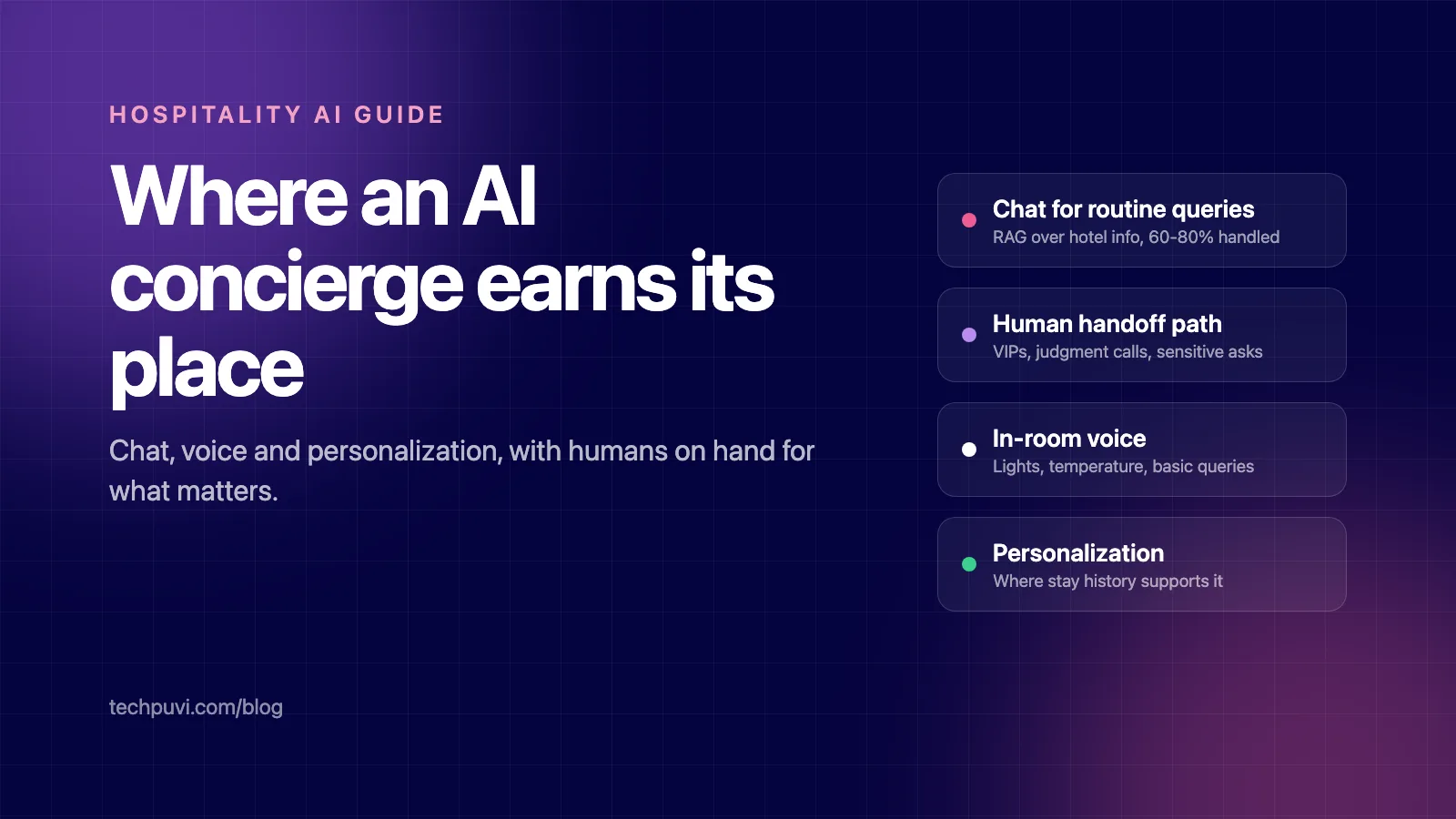
An AI concierge for hospitality has moved from novelty to working product. This guide is for hotel owners, GMs and product teams deciding where an AI concierge should sit in the guest journey: what works today across chat, voice and personalization, what is still emerging, where humans stay in charge, and the implementation patterns that hold it together. The interesting question is no longer "does it work?" but "where does it earn its place?"
Key takeaways at a glance
Capability | Status | What it does well |
|---|---|---|
Chat-based guest service | Works | Deflects routine queries and frees human staff for higher-value work |
In-room voice | Works for control | Lights, temperature and basic queries |
Cross-stay personalization | Emerging | Recommendations across food, activities and services |
Complex requests | Human-led | The human concierge stays in charge |
Where an AI concierge works today
Chat-based guest service on WhatsApp or the hotel app
Guests ask the same questions every day: "What time is breakfast?" "Can I get extra towels?" "How do I get to the conference center?" These arrive over WhatsApp or the hotel app chat, and they are exactly the questions a well-grounded assistant answers best.
An LLM with RAG over hotel information handles 60-80% of routine queries without human escalation. The remaining share needs a proper handoff to a human for anything complex, so the guest never feels the conversation has stalled.
Voice in-room
A smart speaker or wall panel handles requests such as "Turn off the lights." "What's the gym timing?" "I need extra pillows."
It is convenient for tech-comfortable guests, and it is useful for guests who are less comfortable with technology when it is designed simply: short prompts, clear confirmations and an obvious way to reach a person.
Pre-arrival personalization
An email or WhatsApp message before arrival can ask about preferences, propose itineraries and upsell experiences. The AI personalizes the message based on stay history, which makes it feel like a note from the hotel rather than a broadcast. Pre-arrival messaging pairs naturally with a strong direct booking strategy, since direct guests are the ones whose preferences you actually hold.
Post-stay engagement
After checkout, the concierge sends a personalized thank-you, requests a review and recommends a return visit.
Where AI concierge capabilities are emerging
Cross-stay activity recommendations
"Last time you stayed, you enjoyed X. This visit, we recommend Y." This is promising, and it needs guest-history data to work. Without that history the recommendation is a guess.
Complex booking assistance
Multi-restaurant, multi-day experience planning is a hard problem. It involves availability across several systems, preferences that shift during the conversation, and trade-offs a guest wants to talk through.
Multi-lingual guest service
Real-time translation in chat is increasingly viable, and it widens who the concierge can serve well.
Where humans stay in charge
Situation | Why a human leads |
|---|---|
VIPs, complex requests, anxious guests | Humans win on empathy; AI is not a replacement for the human concierge here |
Operational decisions, such as "Can I get a late checkout?" | Requires staff judgment, not AI |
Privacy-sensitive requests, such as "Send a doctor to my room" | Escalate to a human immediately |
Implementation patterns for a hotel AI concierge
RAG over hotel information
Hotel-specific information is indexed, and the AI retrieves the relevant content for each query. This is what keeps answers about your property, your timings and your amenities rather than generic ones.
Tools that call hotel APIs
The AI can call hotel APIs to book a restaurant, schedule a wake-up call or request housekeeping. Those calls depend on the systems behind them, which is why PMS modernization often comes up in the same conversation.
Handoff to human staff
When the AI is uncertain or the topic is sensitive, it hands off to human staff. Design this path first, not last.
Multi-language support
Indian hotels need English, Hindi and regional languages. International chains need more.
What guests value in an AI concierge
Fast responses
Honesty about limits ("I'm an AI assistant; I'll get a human if needed")
No hallucinated amenities that do not exist
No upsell attempt in every interaction
Common pitfalls and how to avoid them
Pitfall | What happens |
|---|---|
Over-promising AI capability | Disappoints guests |
Hallucinations | Wrong information embarrasses the hotel |
No handoff | The guest is stuck in an AI loop |
No personalization | Generic answers feel robotic |
Most of these trace back to scoping and grounding rather than to the model itself, a pattern we see across AI integration projects generally. A guest-facing assistant also needs the same care any AI feature does around prompt injection and data exposure; our guide to threat modeling AI features covers that side.
What we recommend
Run a chat-based concierge for routine queries. Give it a human handoff path. Add personalization where the data supports it. Avoid voice as a gimmick.
The best AI concierge answers the routine instantly and knows exactly when to bring in a person.
FAQs
Which vendors offer an AI concierge for hotels?
There are multiple commercial options, and custom builds are common at scale.
Which model should power it?
A GPT-4-class model or Claude works for general guest service; specialized models suit needs that demand high accuracy.
What is the ROI of an AI concierge?
It is hard to measure directly. The returns show up as staff time freed and a lift in guest satisfaction.
Planning an AI concierge for your property? Explore our AI integration services and our work in travel and hospitality, or talk to Techpuvi about hospitality AI.