
A hotel Property Management System (PMS) is the operational backbone: reservations, check-in and check-out, billing, housekeeping coordination, and integration with everything else. That is why hotel PMS modernization is delicate work, since the system has to keep running while you replace it. This guide is for hotel groups and independent operators weighing a move from a legacy PMS to a cloud-native one, and it covers the options, the work involved, the pitfalls and a realistic timeline.
Key takeaways for hotel PMS modernization
Big-bang PMS replacement rarely succeeds; phased modernization wins.
Cloud-native PMSs (Cloudbeds, Mews, custom) offer real benefits but require operational discipline.
Integration is the hardest part: channel managers, payment, POS, IoT.
Change management with front-desk staff is critical.
Realistic timeline: 12 to 24 months for serious hotel groups.
What a hotel PMS actually does
Before planning a replacement, list everything the current system carries. A PMS is rarely just a booking screen. It typically handles:
Reservations (direct and channel)
Check-in and check-out
Folios and billing
Housekeeping coordination
Maintenance tracking
Reporting
An integration hub for everything else: POS, channel manager, OTA, payment, CRM, loyalty and more
That last item is the one that decides how hard a migration will be. Every connection the PMS holds today has to be rebuilt or reconnected tomorrow. If channel distribution is a big part of your setup, our guide to channel manager architecture covers how those connections are put together.
Why modernize: legacy PMS vs cloud PMS
Legacy PMSs include Opera, Protel and OnQ for major chains, and Hotelogix and others in the mid-market. Here is how they compare with modern cloud PMSs on the points that usually drive the decision.
Area | Legacy PMS | Modern cloud PMS |
|---|---|---|
Product updates | Slow upgrades | Faster product evolution |
Mobile | Limited mobile interfaces | Mobile-native |
Integrations | API limitations restrict modern integrations | Open APIs |
Vendor relationship | Vendor lock-in | Easier to connect other tools through APIs |
Cost | A cost concern in itself | Lower upfront cost (subscription) |
Four PMS modernization options
There is more than one way to move off a legacy system. The right one depends on your size, your workflows and how much operational risk you can accept.
Replace with a cloud PMS
Cloudbeds, Mews and RoomRaccoon are established cloud-native options. It is a big switch, with operational risk during the transition.
Build custom
Suited to large groups with specific workflows. It is a high investment.
Wrap and extend
Keep the legacy PMS and build a modern API and UI layer on top. This gives the slowest progress but the lowest risk. The same approach works well for other ageing systems, as we describe in how we rescue legacy codebases.
Phased modernization
Replace specific modules over time: front desk first, housekeeping second, and so on.
Option | Best for | Trade-off |
|---|---|---|
Replace with cloud PMS | Teams ready for a big switch | Operational risk during transition |
Build custom | Large groups with specific workflows | High investment |
Wrap and extend | Keeping the legacy core in place | Slowest progress, lowest risk |
Phased modernization | Established hotels | Modules move one at a time |
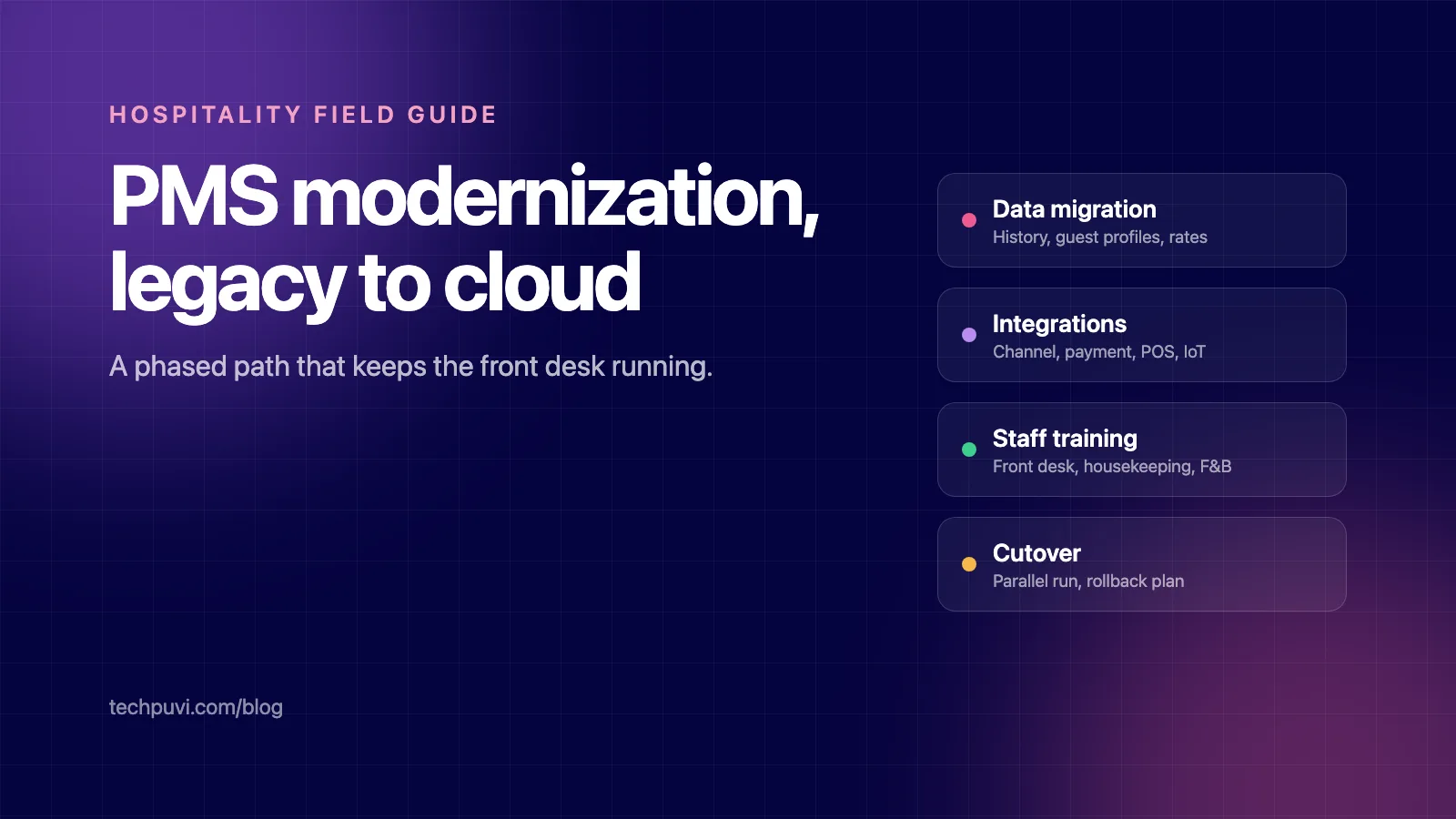
What a PMS migration involves
Data migration
Reservation history, guest profiles, rates and room metadata all have to move. For serious chains this is months of work.
Integration replacement
The channel manager, payment gateway, POS and IoT all need to re-integrate with the new system.
Staff training
Front desk, housekeeping and F&B teams all need training, because the cloud PMS UX is different from the legacy one.
Cutover plan
A parallel run for weeks before full cutover is common. A rollback plan is critical.
Cloud PMS benefits in practice
Mobile interfaces for housekeeping and maintenance
Real-time syncing across properties (for chains)
API access for custom integrations, such as a direct booking engine (see direct booking systems that beat OTAs) or dynamic pricing
Faster vendor product evolution
When not to modernize your PMS
A 50-room independent property: the legacy system works and the ROI is unclear.
Very specialized workflows: a cloud PMS may not fit.
Common PMS modernization pitfalls
Pitfall | What happens |
|---|---|
Big-bang cutover | Operations chaos |
Underestimating integration | Channel manager, payment and the rest must work on day one |
Staff training shortcut | Adoption fails |
Data migration accuracy | Bad migrations corrupt history |
What we recommend
Phased modernization for established hotels. A cloud PMS for new properties. Heavy change management throughout.
Phase the move, budget for integration, and bring the front desk with you.
FAQs
How is cloud PMS pricing structured?
Per-room-per-month subscription, with ₹500 to ₹2,500 a typical range.
How complex is PMS integration?
A PMS has dozens of integration points, so budget months for them.
Do cloud PMSs support multi-property groups?
Most cloud PMSs support multiple properties; verify this for your specific chain.
How long does hotel PMS modernization take?
For serious hotel groups, a realistic timeline is 12 to 24 months.
Planning a move off a legacy system? Talk to Techpuvi about PMS modernization, or see how we work across travel and hospitality.