
Real estate lead scoring has unique characteristics. Buyers research for months, intent signals are subtle, and brokers act on hunches. AI can help, but only with the right design. This guide is for PropTech product teams and brokerages who want a score that brokers actually use: which signals matter, how to build the model in stages, what to show the broker, and how to measure whether it works.
Key takeaways for real estate lead scoring
Behavioral signals (search depth, return visits, specific actions) outperform demographic scoring.
Combine with broker feedback on actual outcomes; loop-closed scoring beats static.
Surface why a lead scored high; opaque scores get ignored by brokers.
Don't expect 90% accuracy; even 65% beats brokers' baseline.
Which signals predict a real estate buyer
Signals fall into three groups. Behavioral and intent signals are the predictive ones. Demographic alone is weak.
Signal group | Examples | Predictive strength |
|---|---|---|
Behavioral | Number of return visits, time on listing pages, properties favorited, properties shared, visit booked, EMI calculator used, documentation downloaded, specific locality searches | Strong |
Intent | Pre-approved loan, move-in date specified, multiple property visits, specific feature requirements (school nearby, parking) | Strong |
Demographic | Age, location, income (where available) | Weaker |
Most behavioral signals come from your own listing site and app, so instrument them early. If your listings are also how buyers find you, our guide to SEO architecture for real estate listing platforms covers the other half of that funnel.
Building the model in four stages
Stage 1: Rules-based scoring
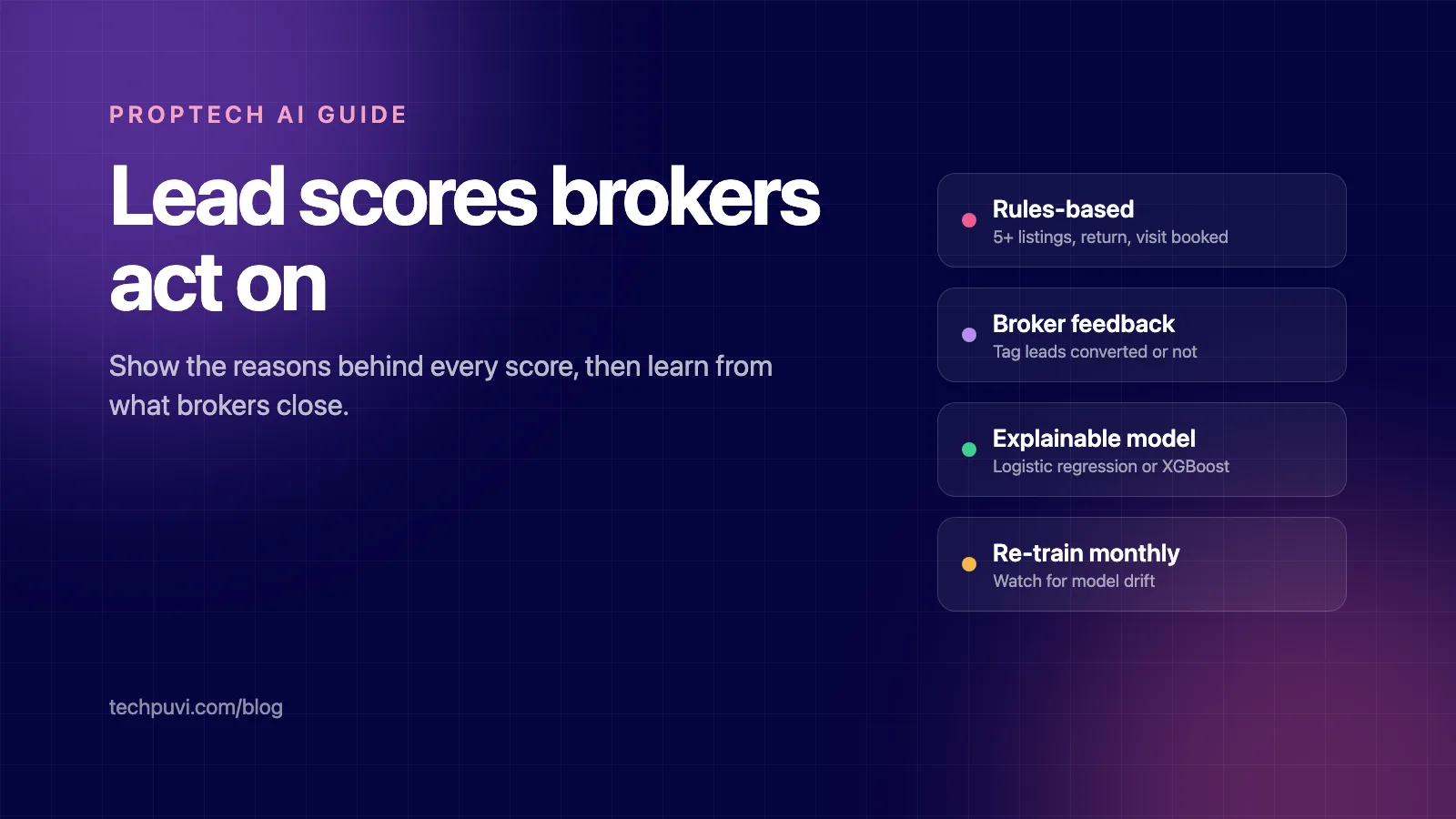
Start with rule-based scoring. "Visited 5+ listings, returned within 7 days, booked a visit" = hot. This bootstraps the system and lets brokers see the signals before any model exists.
def is_hot(lead):
    # Stage 1 rule: visited 5+ listings, returned within 7 days, booked a visit
    return (
        lead.listings_visited >= 5
        and lead.days_since_last_return <= 7
        and lead.visit_booked
    )
Stage 2: Labeled feedback
Brokers tag leads as converted or not. Those tags become your training data.
Stage 3: ML model
Train a classifier on outcomes. Logistic regression or gradient boosting (XGBoost) is lightweight enough and explainable.
Stage 4: Iterate
Re-train monthly and watch for model drift.
What brokers need from a lead score
Not a number. Reasons.
"Lead score: 87 (Visited 6 listings; spent 22 minutes on Bandra 3BHK; pre-approved loan confirmed; visit booked Tuesday)": this they act on.
"Lead score: 87" alone, they ignore. Every score should travel with the two or three signals that produced it.
Integrating the score into the CRM
Score visible in the CRM lead list.
Top-scored leads automatically routed to senior brokers.
Daily digest of hot leads emailed.
The score is only as useful as the screen brokers already work in. See agent CRM features that actually get used in Indian real estate for where it should sit.
Approaches that do not convert
Approach | Why it falls short |
|---|---|
Black-box deep learning | Brokers won't trust it. Stick with explainable models. |
Demographic-heavy scoring | Misses the actual signal. |
Over-segmentation | 20 lead categories overwhelm. |
Static scores | Lead behavior changes; the score should too. |
Measuring lead scoring outcomes
Track:
Conversion rate by score band
Broker action rate by score band
False positives (high score, no conversion) by reason
Then iterate on the signals and the model.
Common pitfalls
No feedback loop. The score never improves.
Surfacing the wrong info to the broker. "Score 87" without context.
Over-promising accuracy. Realistic is 60-70%.
A model that doesn't update. Tastes change; models drift.
What we recommend
Behavioral signals + explainable model + broker feedback loop. Start simple; iterate.
FAQs
Should we build or buy lead scoring?
Pardot and Salesforce have lead scoring, but it is rarely tuned for Indian real estate.
How long until lead scoring delivers value?
2-3 months with adequate behavioral data.
What about privacy?
Behavioral data is personal. Respect DPDP. Our post on the engineering controls the DPDP Act needs covers what that means in code.
Building for real estate? See our real estate and PropTech work and our AI integration services, then talk to Techpuvi about PropTech AI.